General context
Beyond-Li technology has attracted significant attention in recent years due to concerns about the use of geopolitically sensitive, expensive, and/or critical raw materials, such as lithium, nickel, cobalt, and natural graphite. Among several chemical alternatives, sodium- and potassium-batteries are among the best candidates.
Sodium-ion batteries
Sodium-ion batteries (SIBs) have been proposed as potential low-cost energy storage devices for large-scale stationary applications and light electromobility, owing to the abundant and widely distributed sodium resources. Indeed, sodium-based electrodes could be composed of non-critical raw materials, making SIBs sustainable and low-cost. However, the electrochemical performance of SIBs must be further improved through specific strategies that optimize the cathode and anode active materials in terms of energy density and long-term cycling, while maintaining their environmental competitiveness, as well as by designing novel and advanced liquid and solid electrolytes that stabilize the electrode-electrolyte interphase.
The current activities in this field are:
- Bio-waste-derived hard carbon anode materials through a sustainable synthetic route
- Hybrid layered oxide cathode materials for high-energy-density sodium batteries
- Polymer electrolytes
- Surface engineering of aluminum for anode-less sodium batteries
Potassium-ion batteries
PIBs have attracted significant attention because they possess theoretically superior energy and power densities than SIBs, considering their lower standard electrode potential and faster ion diffusion while maintaining material sustainability. However, PIB research is in its infancy; therefore, further advances are necessary in electrode and electrolyte design and in understanding interfacial chemistry to enhance performance. In this context, currently, the group is working on the following:
- Bio-waste derived had carbon anode materials to replace natural graphite
- Understand the degradation mechanism of PIBs
- Study the electrode-electrolyte interphases by surface techniques
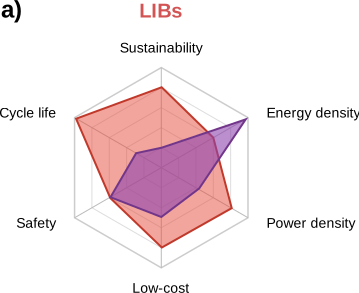
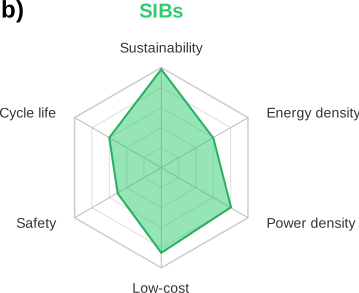
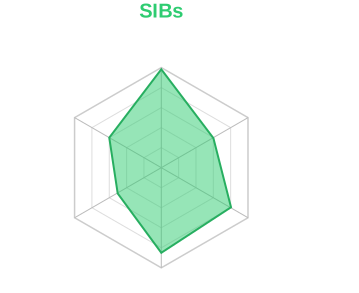
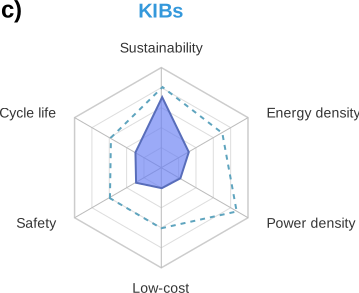
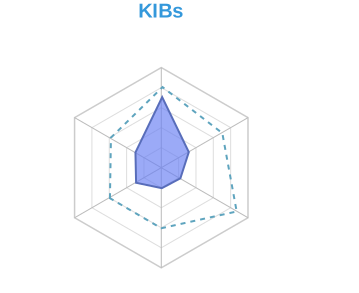
Radar plot of electrochemical, sustainability, and cost properties of the a) Lithium-ion (red: LFP-based and purple: NMC-based batteries), b) sodium-ion, and c) potassium-ion batteries (cyan dots: theoretical values and blue line: experimental values).
Electrode-electrolyte interfaces
The electrolyte is reduced/oxidized during cycling, forming a passivation layer on the electrode surfaces called the solid electrolyte interphase (SEI) on the anode and the cathode electrolyte interphase (CEI) on the cathode. The electrode-electrolyte interphases play a crucial role in the safety, metal deposition, power capability, Coulombic efficiency, irreversible capacity, and cycle life of the batteries. Therefore, understanding the formation mechanism and interphase properties is crucial to developing competitive batteries. Indeed, these interphases are more critical in the sodium-potassium system.
-
Enhancing Sodium-Ion Battery Performance: The Role of Glyoxylic Acetal-Based Electrolytes in Solid Electrolyte Interphase Formation and Stability
M. Gaško, C. Leibing, L. Fridolin Pfeiffer, P. Axmann, A. Balducci, and
M. Zarrabeitia ChemElectroChem, 2025
This study systematically investigates the feasibility of replacing conventional sodium hexafluorophosphate (NaPF6) in carbonate-based electrolytes with sodium bis(fluorosulfonyl)imide (NaFSI) and sodium bis(trifluoromethanesulfonyl)imide (NaTFSI) in a 1,1,2,2-tetraethoxyglyoxal (TEG):propylene carbonate (PC) solvent system tested with hard carbon (HC) anode materials for sodium-ion batteries (SIBs). The influence of electrolyte composition and cycling conditions on the evolution of the solid electrolyte interphase (SEI) and overall electrochemical performance of the HC is comprehensively evaluated by means of electrochemical impedance spectroscopy and X-ray photoelectron spectroscopy. The SEI chemical composition, transport properties, and stability are thoroughly characterized. The results demonstrate that the HC tested in NaFSI/TEG:PC electrolyte exhibits superior performance compared to both the conventional NaPF6/ethylene carbonate (EC):PC system and the NaTFSI/TEG:PC-based alternative, achieving higher initial coulombic efficiencies (ICEs), lower interfacial resistance, and enhanced Na+ transport properties. The improved electrochemical stability of the HC in NaFSI/TEG:PC electrolyte is attributed to the formation of a bilayered SEI, comprising an inorganic-rich inner layer and an organic-rich outer layer. These findings underscore the pivotal role of electrolyte formulation in enhancing the HC SEI characteristics and cycling performance, thereby positioning NaFSI in TEG:PC chemistry as a promising electrolyte candidate for next-generation SIBs. © 2025 The Author(s). ChemElectroChem published by Wiley-VCH GmbH.
-
Solvent-Free Ternary Polymer Electrolytes with High Ionic Conductivity for Stable Sodium-based Batteries at Room Temperature
Batteries and Supercaps, 2023
Transitioning to solid-state batteries using polymer electrolytes results in inherently safer devices and can facilitate the use of sodium metal anodes enabling higher energy densities. In this work, solvent-free ternary polymer electrolytes based on cross-linked polyethylene oxide (PEO), sodium bis(fluorosulfonyl) imide (NaFSI) or sodium bis(trifluoromethanesulfonyl) imide (NaTFSI) and N-butyl-N-methyl-pyrrolidinium-based ionic liquids (ILs, Pyr14FSI or Pyr14TFSI) are developed. Synthesized polymer membranes are thoroughly characterized, verifying their good thermal and electrochemical stability, as well as a low glass transition and crystallinity, thus high segmental mobility of the polymer matrix. The latter results in good ionic conductivities around 1×10⁻³ S cm−1 at 20 °C. The polymer electrolytes are successfully employed in sodium-metal battery (SMB) cells operating at room temperature (RT) and using P2-Na2/3Ni1/3Mn2/3O2 layered oxide as cathode. The electrochemical performance strongly depends on the choice of anion in the conducting sodium salt and plasticizing IL. Furthermore, this solid-state SMB approach mitigates capacity fading drivers for the P2-Na2/3Ni1/3Mn2/3O2, resulting in high Coulombic efficiency (99.91 %) and high capacity retention (99 % after 100 cycles) with good specific capacity (140 mAh g−1). © 2023 The Authors. Batteries & Supercaps published by Wiley-VCH GmbH.
-
Stabilization of P2 Layered Oxide Electrodes in Sodium-Ion Batteries through Sodium Evaporation
Communications Materials, 2024
Sodium-ion batteries are well positioned to become, in the near future, the energy storage system for stationary applications and light electromobility. However, two main drawbacks feed their underperformance, namely the irreversible sodium consumption during solid electrolyte interphase formation and the low sodiation degree of one of the most promising cathode materials: the P2-type layered oxides. Here, we show a scalable and low-cost sodiation process based on sodium thermal evaporation. This method tackles the poor sodiation degree of P2-type sodium layered oxides, thus overcoming the first irreversible capacity as demonstrated by manufacturing and testing all solid-state Na doped-Na~1Mn0.8Fe0.1Ti0.1O2 ǀǀ PEO-based polymer electrolyte ǀǀ Na full cells. The proposed sodium physical vapor deposition method opens the door for an easily scalable and low-cost strategy to incorporate any metal deficiency in the battery materials, further pushing the battery development. (Figure presented.) © The Author(s) 2024.
-
Could Potassium-Ion Batteries Become a Competitive Technology?
Maider Zarrabeitia, Javier Carretero-González, Michal Leskes, Henry Adenusi, Boyan Iliev, Thomas J. S. Schubert, Stefano Passerini, and Elizabeth Castillo-Martinez
Energy Materials, 2023
Potassium-ion batteries (PIBs) have attracted significant attention as a complement to lithium-ion and sodium-ion batteries (SIBs). PIBs can theoretically provide higher specific energy and power density than SIBs due to lower standard electrode potential of K/K+ and faster K+ ion diffusion, maintaining the benefits of low-cost and sustainability. However, research on PIBs is in its infancy; therefore, further efforts are necessary to enhance their performance and position them as a competitive technology. In this perspective, the remaining challenges and possible strategies to advance the development of PIBs are presented.
-
Influence of the Current Density on the Interfacial Reactivity of Layered Oxide Cathodes for Sodium-Ion Batteries
Energy Technology, 2022
The full commercialization of sodium-ion batteries (SIBs) is still hindered by their lower electrochemical performance and higher cost ( W−1 h−1) with respect to lithium-ion batteries. Understanding the electrode–electrolyte interphase formation in both electrodes (anode and cathode) is crucial to increase the cell performance and, ultimately, reduce the cost. Herein, a step forward regarding the study of the cathode–electrolyte interphase (CEI) by means of X-ray photoelectron spectroscopy (XPS) has been carried out by correlating the formation of the CEI on the P2-Na0.67Mn0.8Ti0.2O2$ layered oxide cathode with the cycling rate. The results reveal that the applied current density affects the concentration of the formed interphase species, as well as the thickness of CEI, but not its chemistry, indicating that the electrode–electrolyte interfacial reactivity is mainly driven by thermodynamic factors. © 2022 The Authors. Energy Technology published by Wiley-VCH GmbH.